
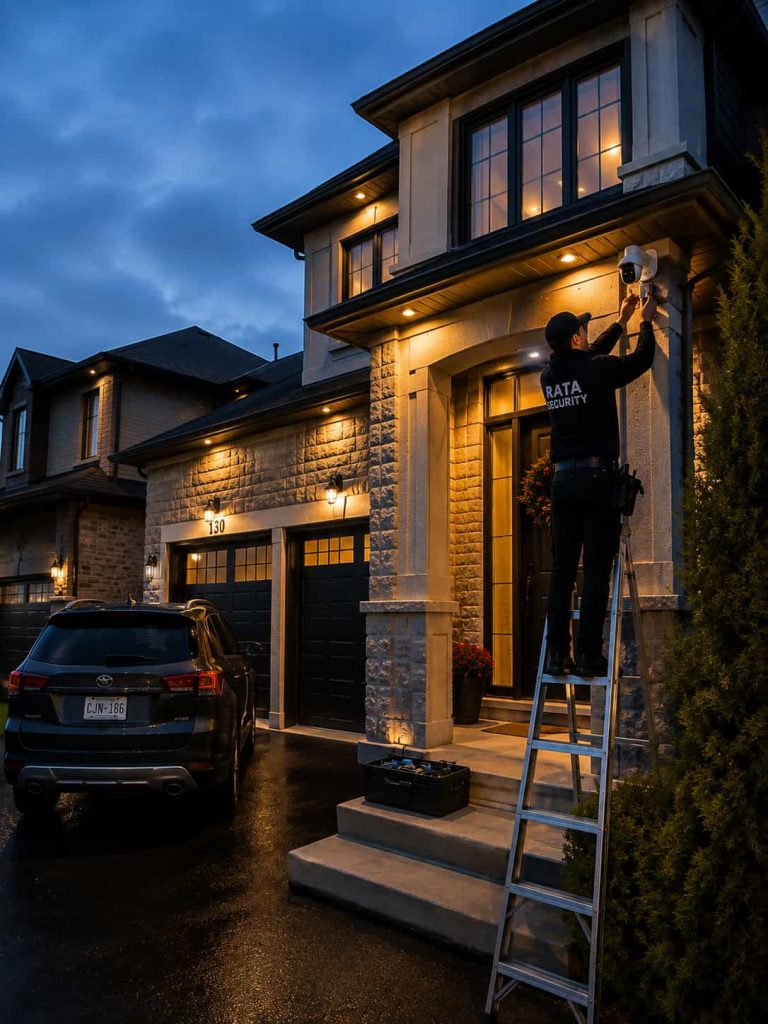
What Toronto Homes Actually Need Coverage For
Camera placement should follow the way properties in this city actually get targeted, not a generic four corner layout sold with a boxed kit. Three patterns drive nearly every residential job we do in the GTA.
Vehicle theft is the dominant one. Relay attacks on keyless entry vehicles happen in the driveway, at night, usually in under sixty seconds, and the footage that matters is a clear face at the driver door and a readable plate at the curb. A single camera above the garage aimed at the whole driveway will show you that it happened and give you nothing usable beyond that. Package theft is the second, which needs a camera at porch level rather than roofline, because a camera mounted at the eaves captures the top of a hood and nothing else. The third is perimeter and rear access, since side gates, rear doors and basement entrances are where forced entry attempts concentrate, and those are exactly the areas homeowners cannot see from inside.
Home Camera Systems We Install
The right system for a house depends on whether it is finished or under renovation, how far the runs are, and whether you want everything recording continuously or only on motion. These are the configurations we install across Toronto.
Hardwired IP Systems Over Cat6 and PoE
This is what we recommend for almost every house. Each camera runs on a single Cat6 cable carrying both video and power through Power over Ethernet, recording to an NVR kept in a basement, closet or utility room. Nothing depends on Wi-Fi signal strength and nothing needs a battery changed in February.
- 4MP to 8MP resolution with lens selection matched to the distance you actually need to identify someone, using the DORI standard
- Local storage from 1TB to 4TB, typically 30 days of continuous recording for a four to eight camera home
- No subscription, no cloud fees, and footage that stays on your property
- IP66 weather rated housings tested through Toronto winters
- Remote viewing through Hik-Connect or DMSS on iOS and Android
Night Performance and Motion Filtering
The two complaints we hear most about existing home systems are that night footage is unusable and that the phone will not stop buzzing. Both are solved at the camera, not by adjusting settings afterward.
- Hikvision ColorVu records in full colour at night rather than infrared grey, which is the difference between a dark jacket and a red one
- Hikvision AcuSense and Dahua WizSense filter human and vehicle from wind, snow, rain and passing headlights
- Motion zones are drawn to exclude the sidewalk and the neighbour’s driveway, so you are alerted to your property only
- Two way audio at the front door where you want to speak to someone without opening it
Doorbell Cameras and Entry Coverage
A doorbell camera covers the person standing at your door, which is useful but narrow, and it is not a substitute for a properly placed entry camera. We usually install both.
- Doorbell camera for visitors, deliveries and two way conversation from your phone
- A separate porch level camera for identification quality footage, since doorbell cameras use wide angle lenses that distort faces at distance
- Integration with the same NVR so doorbell footage is retained alongside everything else rather than living in a separate app
Wireless and Subscription Free Options
Hardwiring is not always practical, particularly in a rental, a condo, or a finished home where a specific run would mean opening a ceiling. In those cases we specify equipment that still keeps your footage local.
- eufy systems recording to a HomeBase hub on site, with no monthly fee
- TP-Link cameras for supplementary interior coverage or smaller properties
- Battery and solar options for detached garages and sheds with no power run
- Hybrid builds where the main exterior positions are hardwired and interior positions are wireless
Where We Place Cameras on a Toronto Home
Placement is the entire job. The same camera at the wrong height and angle is the difference between evidence and a silhouette, and this is where most self installed systems go wrong.
Front and Driveway
A face capture camera at porch level, roughly two and a half metres, plus a driveway camera angled to catch a plate at the curb rather than the roof of a car. Roofline only coverage is the most common placement mistake we correct on existing systems.
Rear and Side Access
Rear door, side gate and basement entrance, since these are the approaches that cannot be seen from inside the house and where forced entry attempts concentrate. Coverage here matters more than a second front camera.
Garage and Detached Structures
Interior garage coverage for vehicles and tools, plus a camera on any detached garage or shed. These runs often need conduit or a wireless bridge, which we identify during the assessment rather than on installation day.
Interior Positions
Most homeowners want one or two interior cameras covering the main entry hall and stairwell, so anyone who gets past the exterior is recorded. We do not install interior cameras in bedrooms or bathrooms and will advise against it if asked.
Our Home Installation Process
A residential install happens inside a home people live in, which changes how the work is done more than it changes what gets installed. The four steps below are built around leaving your house exactly as we found it.
Step 1: Free On Site Assessment
We walk the property with you, check for existing coax or Cat6 that can be reused, look at lighting conditions at night, and measure identification distances at each proposed position. Takes 30 to 60 minutes and you receive a written fixed price quote, same day or next.
Step 2: Concealed Cabling
Cable is run through attics, soffits, wall cavities and basement joists so nothing is visible on your exterior. Routes are agreed with you before any drilling starts. Holes are patched and painted to match the surrounding surface, and we clean up before we leave.
Step 3: Recorder Setup and Phone Access
The NVR is installed somewhere discreet and out of reach, recording schedules and motion zones are configured, and remote access is set up on your phone and any family devices you name. Every device gets a unique password. Nothing is left on factory defaults.
Step 4: Training and Handoff
Before we leave you can pull up live view, scrub back through playback, export a clip for police or insurance, and adjust a motion zone yourself. You get a written card with your credentials and our direct line, plus a 2-year warranty on workmanship and equipment.
Home Security Camera Installation Cost in Toronto
Cost on a residential job is driven far more by how difficult the cable runs are than by camera count, which is why a bungalow and a three storey semi with finished walls can differ substantially at the same camera count.
| System | Typical build | Installed cost (CAD) |
| 4 cameras | Front, driveway, rear, side. 2TB NVR, Cat6 | $1,200 to $1,800 |
| 6 cameras | Adds garage and second side approach | $1,600 to $2,300 |
| 8 cameras | Full perimeter plus interior entry. 2TB to 4TB NVR | $2,000 to $2,800 |
| Doorbell camera added | Wired doorbell with NVR integration | $250 to $450 |
| Large or multi structure property | Detached garage, long runs, conduit | Quoted after assessment |
Reusing existing coax from an older system typically saves $300 to $800. Difficult runs through finished plaster, exterior masonry or a third storey add to it. Either way the quote is fixed before work begins.
Privacy Rules for Home Cameras in Ontario
Homeowners in Ontario have wide latitude to record their own property and comparatively little to record anyone else’s, and the line between the two is where disputes with neighbours start. Your cameras may cover your own land, your driveway, your entrances and the public sidewalk that necessarily falls within frame. They may not be aimed into a neighbour’s yard, windows or any space where someone holds a reasonable expectation of privacy. If a camera has to face that direction to cover your own side entrance, the fix is a privacy mask applied in the camera settings, which blacks out that portion of frame permanently in both live view and recordings. Audio recording carries stricter rules than video and should be limited to your own entrances. We handle all of this at the placement stage, which avoids the conversation with a neighbour that otherwise tends to happen after installation rather than before.
Areas We Serve
We install home camera systems across Toronto and the wider GTA, including the Downtown Core, Midtown, the East and West ends, North York, Scarborough, Etobicoke, Markham, Mississauga, Brampton, Vaughan, Richmond Hill and Burlington. Same day emergency service is available across Metro Toronto seven days a week.
Book a Free Home Assessment
Tell us the property type, number of floors, whether there is a detached garage, and the areas you want covered. We respond within 24 hours with a no obligation assessment and a written fixed price quote.
Phone: (647) 594-1360 | Email: [email protected] | Online: Free Quote Form


