
What an Alarm System Does That Cameras Cannot
Almost every client who calls us about alarms already has cameras, or is buying both at once. The reason is that the two systems answer different questions and neither substitutes for the other.
A camera is a passive record. It captures an intrusion perfectly and does nothing to stop it, and unless someone happens to be watching a live feed at that exact moment, you learn about the event afterward. An alarm is an active response. The moment a contact breaks or a motion detector triggers in an armed area, a siren sounds, a notification hits your phone, and if the system is monitored, a central station begins a dispatch procedure. Deterrence is a real part of this: an audible siren ends a substantial share of intrusions within seconds, because the intruder’s assumption changes from unoccupied to detected. And an alarm covers scenarios a camera never will, including panic buttons for staff safety, flood detection under a basement laundry, and low temperature alerts that catch a failed furnace before the pipes burst in February.
Alarm System Components We Install
An alarm system is a set of detection devices reporting to one panel, and the quality of the system is determined almost entirely by whether the right detector was chosen for each opening and space. These are the components we specify.
Control Panel and Keypads
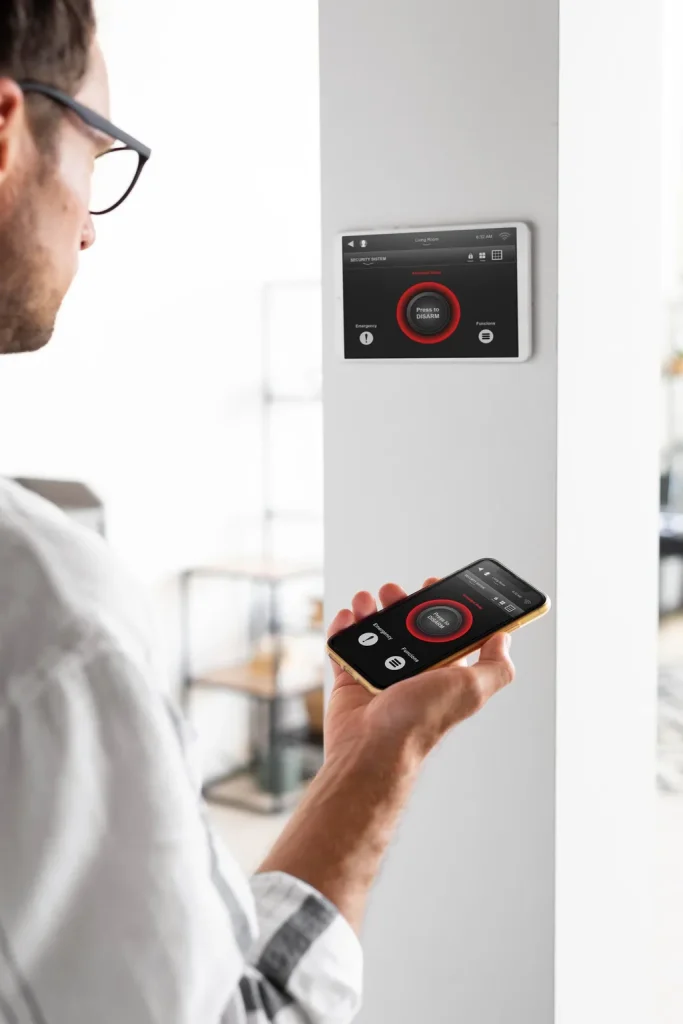
The control panel is the core of the system, processing every sensor signal and managing arming states. Keypads or a mobile app handle arming and disarming.
- Stay and away arming modes, so perimeter protection stays active while you are home
- Entry and exit delays configured per door so the system is usable day to day
- Individual user codes, so the log shows who armed or disarmed and when
- Backup battery so the panel keeps running through a power outage
Perimeter Detection
The strongest alarm design catches an intrusion at the boundary rather than after someone is already inside and moving through your space.
- Door and window contacts on every accessible opening, including basement and garage entries
- Glass break detectors that recognise the acoustic signature of breaking glass, covering multiple windows from one device
- Shock and vibration sensors for doors and windows where forced entry is the likely method
- Exterior beam detectors for yards, gates and commercial perimeters
Interior Detection
Interior devices are the second layer, and they exist to catch anyone who defeated the perimeter or entered through a point that cannot be contacted.
- PIR motion detectors covering hallways, stairwells and open areas
- Dual technology detectors combining infrared and microwave for environments where false triggers are a concern
- Pet immune sensors calibrated to ignore animals under a set weight
- Panic buttons at reception desks, tills and bedside positions
Environmental Sensors
These are the devices that quietly justify the system in a Toronto winter, and they are the ones most homeowners never think to ask for.
- Water and flood sensors beside laundry, water heaters and sump pumps
- Low temperature sensors that alert before a heating failure becomes a burst pipe
- Smoke and carbon monoxide detection integrated into the alarm rather than standalone
- Freezer and cold storage temperature monitoring for restaurants and food businesses
Communication and Sirens
How the panel reports matters as much as what it detects, because a system that only reports over the internet is defeated by cutting one cable.
- Dual path reporting over both IP and cellular, so the loss of one path does not silence the system
- Interior and exterior sirens plus strobe for visual indication
- Push notifications with event detail to named phones
- Tamper detection on panel, sirens and devices
Monitored or Self Monitored
This is the decision that determines your ongoing cost, and it is worth making deliberately rather than defaulting to whatever the installer sells. Both are legitimate and we install both.
Central Station Monitoring
A staffed monitoring centre receives every alarm signal, attempts verification, and initiates police or fire dispatch according to a procedure you approve. This is what most insurers recognise for a premium discount, and it is the appropriate choice for commercial properties and for anyone who cannot reliably respond to their own phone. It carries a monthly fee.
Self Monitoring
The system reports directly to your phone with no monitoring fee. You decide whether to call police, check cameras, or contact a neighbour. This suits homeowners who want the deterrent and the alert without a recurring cost, and it works well when the alarm is paired with cameras so you can verify the event yourself in seconds.
Camera Verified Alarms
When the alarm and camera systems are integrated, an alarm event pushes a live view rather than just a signal. This matters more than it sounds: it lets you distinguish a genuine intrusion from a cleaner arriving early before anyone is dispatched, which is the single most effective way to avoid false alarm consequences.
Alarm Systems for Homes and Businesses
The detection strategy shifts substantially between a house and a commercial property, less because of size than because of who has legitimate access and when.
Home Alarm Systems
Residential systems focus on perimeter contacts at every ground floor opening, motion coverage on main circulation areas, and environmental sensors in basements and utility spaces. Most homes run six to twelve devices with stay mode arming overnight. Integration with the doorbell and camera system means one app rather than three.
Commercial Alarm Systems
Businesses need per user codes for accountability, scheduled arming so the system self arms if someone forgets at close, partitioned areas so a warehouse can be armed while the office is occupied, and open and close reporting so an owner knows the store was unlocked at the expected time. Panic buttons at tills and reception are standard, and integration with access control means a valid credential can disarm the zone automatically.
Our Installation Process
Alarm work is less physically invasive than camera or access control installation, but the design stage carries more weight because a poorly zoned system gets disarmed permanently by its own users.
Step 1: Site Assessment and Zone Design
We walk the property, identify every accessible opening, determine which spaces need interior coverage, and design zones around how you actually use the building. You get a device schedule and a written fixed price quote.
Step 2: Device Installation
Contacts, detectors and sirens are installed and either hardwired or configured as encrypted wireless devices. Wireless is often the right answer in a finished home, since it avoids opening walls, and modern encrypted wireless does not have the reliability problems older systems did.
Step 3: Panel Programming and Testing
Zones, user codes, entry and exit delays, arming schedules and notification routing are configured to your requirements. Every device is walk tested individually. If the system is monitored, we complete central station registration and test the signal path end to end.
Step 4: Training and Handoff
You and your staff are trained on arming modes, disarming, bypassing a zone, and what to do when the alarm activates. You receive a written system document with zone list, codes and our direct line, plus a 2-year warranty on workmanship and equipment.
Alarm System Installation Cost in Toronto
Alarm pricing is driven by device count and whether the system is wired or wireless, and unlike camera work it is not heavily affected by cabling difficulty when wireless devices are used. Every quote is fixed price before work begins.
| System | Typical build | Installed cost (CAD) |
| Basic home | Panel, keypad, 4 to 6 contacts, 2 motion, siren | $900 to $1,500 |
| Full home | All openings contacted, glass break, environmental sensors | $1,500 to $2,800 |
| Small business | Panel, perimeter contacts, motion, panic button, dual path | $1,400 to $2,500 |
| Commercial, partitioned | Multiple areas, scheduled arming, open and close reporting | $2,500 to $6,000 |
| Warehouse or industrial | Perimeter beams, multiple sirens, camera verification | Quoted after survey |
| Central station monitoring | Optional, billed monthly | Quoted per site |
Adding an alarm system at the same time as cameras usually reduces total cost, because both share the same site visit, the same cable pathways and the same commissioning.
False Alarms and Registration in Toronto
False alarms are the reason alarm systems get abandoned, and in Toronto they also carry a direct cost. Toronto Police Service operates an alarm registration and false alarm reduction program, and repeated false dispatches to the same address attract fees and can affect response priority. The practical implications are worth understanding before installation rather than after the third invoice. Most false alarms come from a small set of causes: motion detectors aimed at heating vents or sunlit windows, pets triggering sensors that were not specified as pet immune, entry delays set too short for the way people actually enter the building, and shared user codes that make it impossible to identify who keeps making the same mistake. We design around all four, and camera verification effectively eliminates the rest by letting you confirm what triggered the alarm before anyone is dispatched. If you are installing a monitored system, confirm the current registration requirements and fee schedule with Toronto Police Service or your local municipality, since these are set by the service and change from time to time.
Areas We Serve
We install and service alarm systems across Toronto and the wider GTA, including the Downtown Core, Midtown, the East and West ends, North York, Scarborough, Etobicoke, Markham, Mississauga, Brampton, Vaughan, Richmond Hill and Burlington. Same day emergency service is available across Metro Toronto seven days a week.
Book a Free Alarm Assessment
Tell us the property type, approximate size, number of ground floor doors and windows, and whether you want monitored or self monitored. We respond within 24 hours with a no obligation assessment and a written fixed price quote.
Phone: (647) 594-1360 | Email: [email protected] | Online: Free Quote Form


