
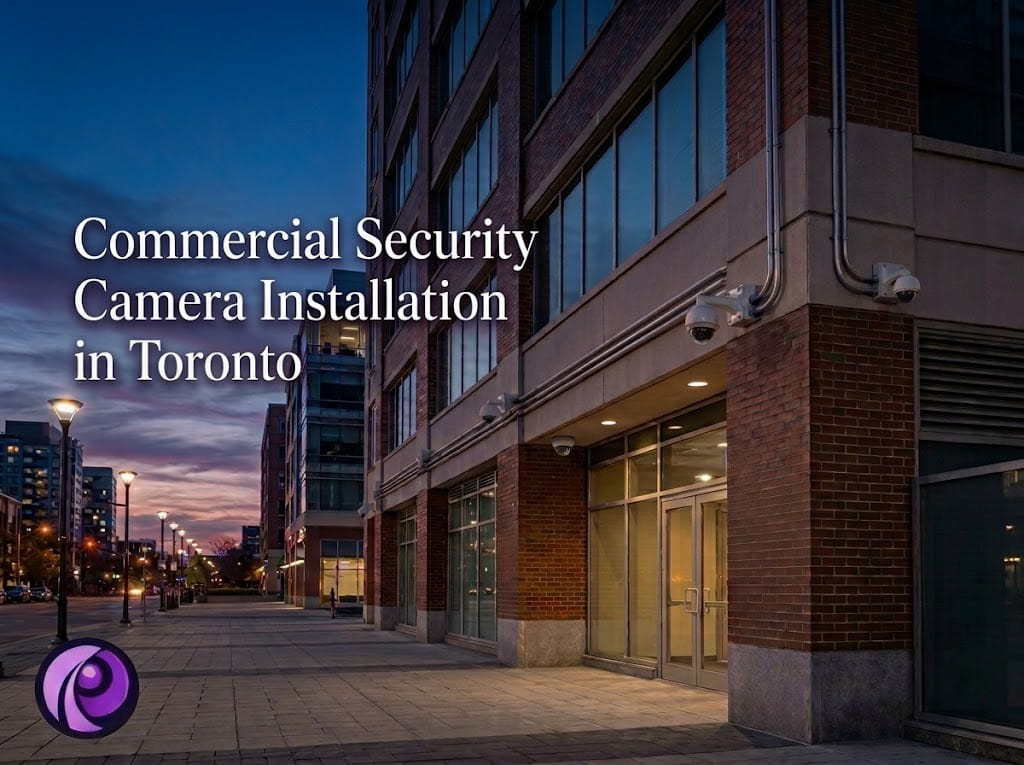
Why Commercial Properties Need a Different System
The gap between a residential setup and a commercial one is not camera count, it is what the footage has to do. A homeowner wants to know who was at the door. A business owner needs footage that stands up when an employee disputes a termination, an insurer questions a shrinkage claim, or a customer alleges a slip and fall six months after the fact.
That changes three engineering decisions. Retention goes from thirty days to sixty or ninety, because commercial disputes surface long after the incident. Redundancy matters, so recorders are specified with RAID storage and a UPS rather than a single unprotected drive. And coverage geometry becomes forensic rather than general, meaning cameras at POS stations and receiving doors are positioned and lensed to capture hands, faces and plates at identification distance under the DORI standard, not simply to show that a person was present.
Commercial Camera Systems We Install in Toronto
The right specification depends on the size of your floor plate, your lighting conditions, and whether footage needs to be reviewed by more than one person from more than one location. These are the configurations we deploy most often for Toronto businesses.
IP Systems Over Cat6 and PoE
Every commercial build we do runs on IP cameras over Cat6 with Power over Ethernet, so a single cable carries both video and power to each device. This is what makes a commercial system extensible: adding cameras later means pulling cable to a patch panel, not redesigning the system.
- 4MP to 8MP resolution with lens selection matched to each zone’s identification distance
- ONVIF compliant hardware so you are never locked to one manufacturer’s roadmap
- NVR or VMS recording on site, with RTSP streams available for integration
- Vandal resistant IK10 housings and IP66 weather rating for exterior and loading dock positions
- WDR imaging at glass entrances and loading bays where backlight would otherwise blow out faces
AI Analytics That Reduce Alert Fatigue
The most common reason a commercial system stops being used is that it generates too many false alerts and staff stop reading them. Modern analytics solve this at the camera rather than at the recorder.
- Hikvision AcuSense filters human and vehicle from wind, rain and shadow movement
- Dahua WizSense for perimeter protection, line crossing and intrusion zone detection
- Hikvision ColorVu for full colour night footage at entrances rather than infrared grey
- People counting and heat mapping for retail floors, useful for merchandising as well as security
Specialized Cameras for Commercial Coverage
Large or awkward commercial spaces cannot be covered properly by fixed dome cameras alone, and trying to do so is how permanent blind spots get designed into a system on day one.
- PTZ cameras for warehouse floors, yards and parking structures, where one motorized unit replaces three or four fixed positions
- LPR cameras at gates and loading entrances, using dedicated shutter settings that standard cameras cannot achieve on moving vehicles at night
- Thermal imaging for perimeter detection at industrial sites, which eliminates false triggers from headlights and animals
- Fisheye cameras for open plan offices and retail floors, covering an entire room from one ceiling position
Integration With Access Control and Alarm
Cameras become substantially more useful when they are tied to the systems that already record who went where, because an event log with matching footage is worth far more than either alone.
- Door events from access control can trigger camera bookmarks, so badge activity is searchable
- Alarm system triggers can push live camera views to a phone rather than just an audible signal
- POS integration overlays transaction data onto footage, which is how cash discrepancies actually get resolved
- Multi site businesses can view all locations through a single VMS interface
Commercial Camera Installation by Property Type
Camera count, placement and retention change significantly depending on what the building does. Below is how we approach the property types we install for most often across Toronto and the GTA.
Office and Professional Buildings
Offices need coverage at reception, elevator lobbies, server rooms and exterior doors, with attention paid to privacy expectations in workspaces. Typical builds run eight to twenty four cameras with sixty day retention and often tie into an existing badge system.
Retail Stores
Retail coverage is driven by shrinkage and liability. That means dedicated POS cameras positioned to capture the transaction and the customer’s face, entrance cameras at head height for identification, and stock room and fitting room approach coverage. People counting is frequently added for merchandising value.
Restaurants and Food Service
Restaurants need kitchen coverage for food safety and staff accountability, bar and till coverage for cash handling, plus patio and rear exit coverage. Cameras in kitchen environments require housings rated for heat and grease, which is a specification detail most general installers miss.
Warehouses and Industrial Facilities
Warehouse coverage is a perimeter and receiving problem before it is an interior one. Loading doors, yard, shipping and receiving desks and high value storage aisles take priority, usually with PTZ for open floor area and LPR at the gate. Retention typically runs sixty to ninety days to cover inventory reconciliation cycles.
Condominium and Multi Tenant Buildings
Multi tenant properties require board approval, defined common area coverage, and a clear policy on who can access footage. We supply the documentation package alongside the technical design, since that is usually what holds up approval.
Our Commercial Installation Process
Commercial projects carry constraints residential ones do not, from after hours access to keeping a floor operational during the install. The process below is built around not interrupting your business.
Step 1: Site Survey and Risk Mapping
We walk the property with you, identify your actual loss and liability points rather than assuming them, check existing cabling and pathways, and measure identification distances at each proposed position. You receive a camera placement plan and a written fixed price quote.
Step 2: Structured Cabling
Cable is run to TIA-568 standard, labelled at both ends and terminated to a patch panel in a proper enclosure. Runs use conduit or existing pathways where required by building code or landlord rules. Work can be scheduled after hours or in phases so operations continue.
Step 3: Recorder Configuration and Access Policy
Recording schedules, motion zones and retention are set to your legal and operational requirements. User accounts are created per role, so a shift manager and an owner do not share credentials. All remote access is encrypted and no device is left on a default password.
Step 4: Staff Training and Documentation
We train the people who will actually use the system on live view, playback, clip export for police or insurers, and motion zone adjustment. You receive a written system document with camera positions, credentials and our direct line, plus a 2-year warranty on workmanship and equipment.
Commercial Security Camera Installation Cost in Toronto
Commercial quoting depends far more on cabling difficulty and building access than on camera count, which is why fixed packages tend to be misleading. The ranges below reflect completed GTA installations and every quote is fixed price before work begins.
| Property type | Typical build | Installed cost (CAD) |
| Small office or retail | 8 cameras, 4K NVR, 30 to 60 day retention | $2,500 to $3,500 |
| Restaurant | 10 to 12 cameras with kitchen and POS coverage | $3,000 to $4,500 |
| Medium commercial | 16 cameras, RAID recorder, UPS | $4,500 to $8,000 |
| Warehouse or industrial | 16 to 24 cameras, PTZ and LPR at gate | $5,000 to $12,000 |
| Multi floor or multi tenant | 32 or more cameras, VMS, access integration | Quoted after site survey |
| Multi site business | Separate recorder per site, central VMS | Quoted per location |
The variables that move a commercial quote most are conduit requirements, concrete or masonry drilling, after hours labour, recorder storage size, and whether existing cable pathways can be reused.
Legal Requirements for Business Surveillance in Ontario
Recording employees and customers puts a business under obligations that a homeowner does not carry, and getting this wrong creates exposure that outlasts whatever you were trying to prevent. Under PIPEDA, a business must give notice that surveillance is in use, which in practice means visible signage at entrances. Cameras must not cover areas where individuals hold a reasonable expectation of privacy, which rules out washrooms, change rooms and similar spaces outright. Coverage of employee work areas should be justifiable on a security basis rather than for performance monitoring. Footage retention should be defined as a policy rather than left to whatever the drive happens to hold, and access to that footage should be limited to named individuals. We factor all of this into the design during the survey, and supply the signage and policy language as part of the handoff.
Areas We Serve
We install commercial camera systems across Toronto and the wider GTA, including the Downtown Core, Midtown, the East and West ends, North York, Scarborough, Etobicoke, Markham, Mississauga, Brampton, Vaughan, Richmond Hill and Burlington. Same day emergency service is available across Metro Toronto seven days a week, which matters when a recorder fails and your insurer requires continuous coverage.
Book a Free Commercial Site Survey
Tell us the property type, approximate square footage, number of entrances and whether any cabling already exists. We respond within 24 hours with a no obligation site survey and a written fixed price quote.
Phone: (647) 594-1360 | Email: [email protected] | Online: Free Quote Form


